
Official DeSoto Arrest Sources
Start with the official record. The DeSoto County jail portal has Current and Released modes, plus name and charge searches and a day-range you set yourself. Current mode lists people still in custody. Released mode covers some who have already left the jail. Neither mode promises a refresh schedule or a stated retention limit, and the portal's photograph display cannot be confirmed without visiting it.
DCSO does not publish a fixed 24-hour, 48-hour, or weekly arrest blotter. Setting the day field to 1 gives a practical same-day view. Try 5 or 7 for a broader query. Those numbers are your choices, not promised publication windows. A Current search alone can miss someone booked and released in the same stretch, so run both modes.
The DCSO Crime Reports page opens a Community Crime Map covering EMS, Arcadia Police Department, and sheriff incidents. Each entry carries a communications or case number that helps identify an event. DCSO calls the data preliminary, evolving, and approximate. The map is not a booking feed, a custody check, or a court disposition.
Agency social accounts post selected enforcement items but follow no verified booking-photo schedule. CodeRED sends emergency and public-safety alerts, not arrest records. Missing a booking entry or an image? File through the DCSO public-records portal and give the name, booking date, and arresting agency as closely as you can.
DeSoto Crime News Outlets
Local publishing here falls into three patterns. One is a recurring county arrest report. Another is event-driven news coverage. The third is historical newspaper archives. None of them matches the sheriff's Current and Released searches. The outlet table below describes what each source actually does rather than ranking them.
| Outlet | Coverage | Photos? | Where |
|---|---|---|---|
| DCSO | Official custody portal, incident map, and selected social releases | Portal photo display unverified; releases may use agency images | Sheriff website and linked channels |
| Arcadia Community Local / Peace River Shopper | Countywide weekly DCSO-derived arrest report | Sampled reports were mainly text lists | Issue hub |
| Gulf Coast News | Event-driven DeSoto and Arcadia stories | Often an agency-supplied image | Individual reports |
| Hoodline Tampa | Occasional summaries of DCSO releases | May carry the agency image | Story pages, not a county blotter |
| The Arcadian / DeSoto Sun | Digitized historical arrest-list material | Varies by old issue | University of Florida digital issues |
Gulf Coast News and Hoodline publish when an event catches editorial attention. Each story is selective by nature. An old Arcadian issue may help you pin down a name or a date. It cannot tell you whether that person sits in custody right now. Present status belongs to DCSO. The court outcome belongs to the DeSoto County Clerk.
DeSoto Weekly Arrest Report
Arcadia Community Local's issue hub is the strongest recurring local arrest-report source available. Sampled issues carry a DCSO-derived report covering a defined Friday-through-Thursday period. The list presents names and booking-charge labels as text. It usually skips photos entirely. Coverage includes all of DeSoto County, Arcadia included, whenever the weekly issue publishes.
The issue interface appears below. It helps a reader find the right edition and reported window. Still, it sits second to the sheriff's live systems for anything current.
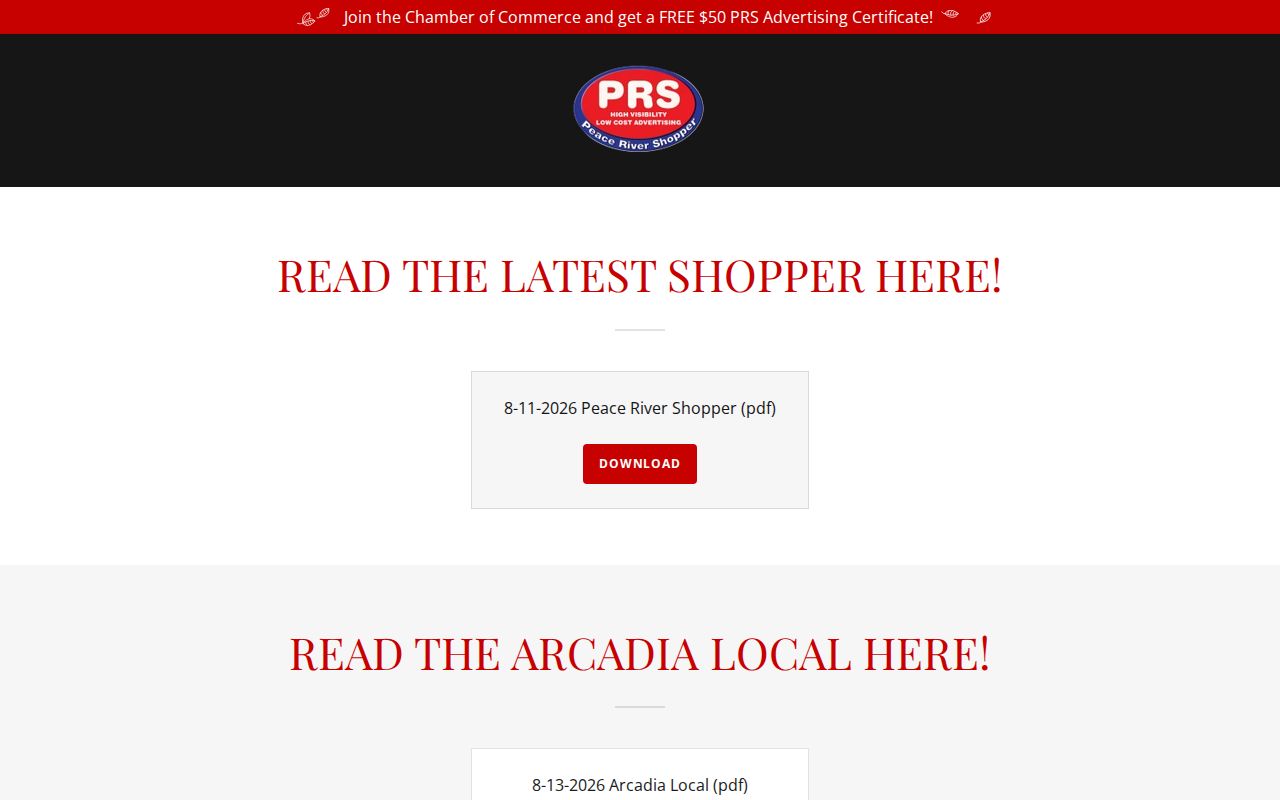
The issue hub works well for discovery and past reporting. Before treating a printed entry as current, search both DCSO custody modes and the Clerk case record.
One sampled September 2025 issue carried a retraction and apology. A wrong name had run in an earlier arrest report. That correction is not an abstract caution. It shows a copied list can carry an identity error even when the publisher drew from public inmate records. So capture the report dates and exact spelling. Then check the source record yourself.
Note: The Friday-through-Thursday range is the newspaper's weekly report window, not a promise about DCSO portal retention or update speed.
How Photos Reach DeSoto News
A news photo can arrive by several paths. It may come from a sheriff or police release, a public-records request, or a copied booking source. DCSO and APD sometimes issue statements with agency images. Selection for a press release only signals that an event drew agency attention. It does not create a full arrest log.
Florida Constitution article I, section 24 and chapter 119 open government records to the public, subject to exemptions. Openness does not force every image online. Victim details, confidential juvenile material, exempt active-investigation content, and sealed or expunged records may be withheld or redacted. An outlet can also decline to publish a booking photo under its own editorial policy.
Florida Statutes section 901.43 covers certain commercial publishers who spread booking photographs and take payment for removal. It does not force every agency or newsroom to erase an image. Want to know how a photo reached a story? Read its credit. Then ask the creating agency for the releasable record.
Unofficial DeSoto Mugshot Sources
Commercial county pages rank last among these channels. They are copied sources. They can omit releases, keep stale entries, or misread a field. They say nothing about how a case ended. A DeSoto County page can still show where an image was republished. Every fact on it needs DCSO and Clerk review to stand.
| Source | Observed scope | Local caution |
|---|---|---|
| Busted Newspaper | Chronological DeSoto stream with photos and booking fields | Its Arcadia tag mixed county jurisdictions. |
| Recently Booked | Claims a rolling last-30-days view and frequent refreshes | Counts, bond, release, and disposition still require official checks. |
| Mugshots.com | DeSoto results observed as largely historical | Archive-prone, not a dependable live feed. |
| Arrests.org | County and year pages with photos and booking data | Observed field placement included implausible values. |
| Mugshots.zone | DeSoto subdomain with dated entries and images | Source details and update handling need verification. |
Here is the Busted Newspaper capture of the county landing page. Treat it as a browsing aid. DCSO keeps the real custody roster, and the Clerk holds the court file.
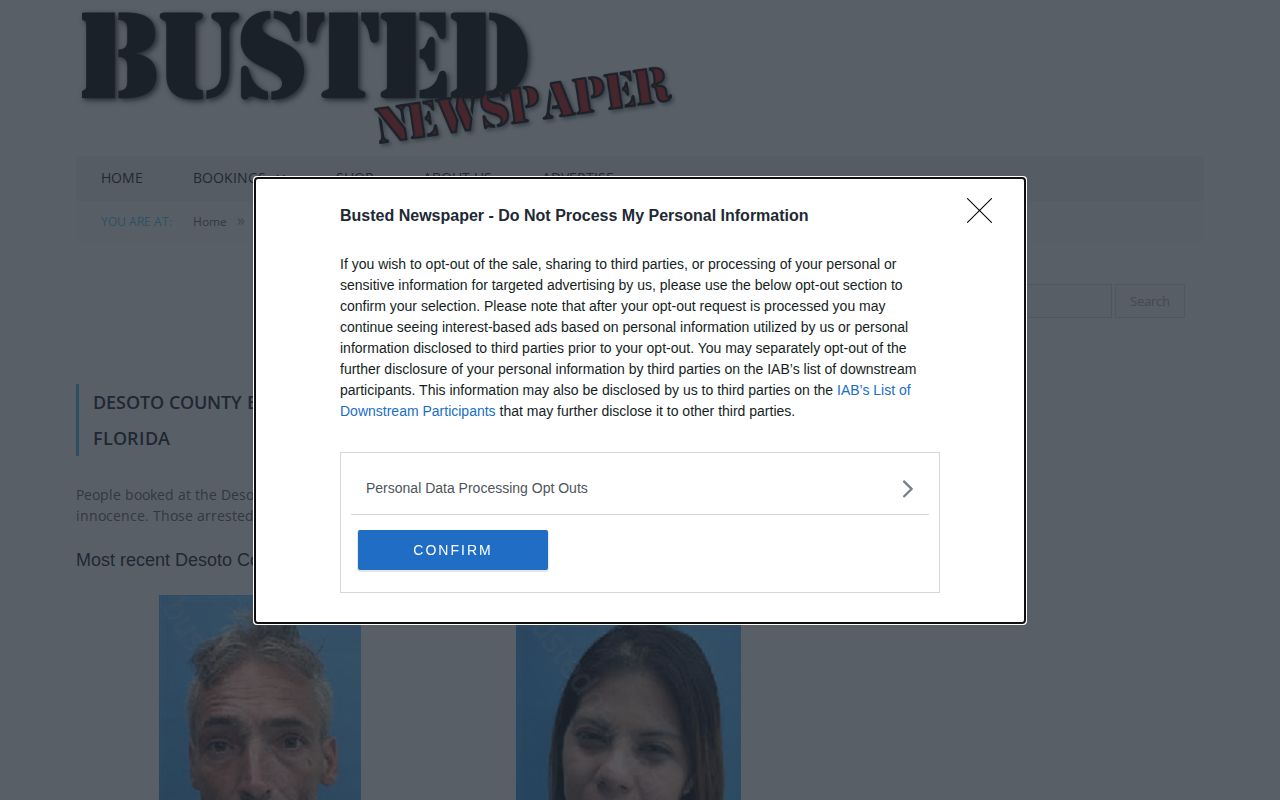
Why do copied booking photos show up so often in searches? The interface below makes that plain. Recently Booked's DeSoto section is one more secondary route, shown here after the official sources. For custody questions, go back to DCSO. For a court outcome, use the Clerk.
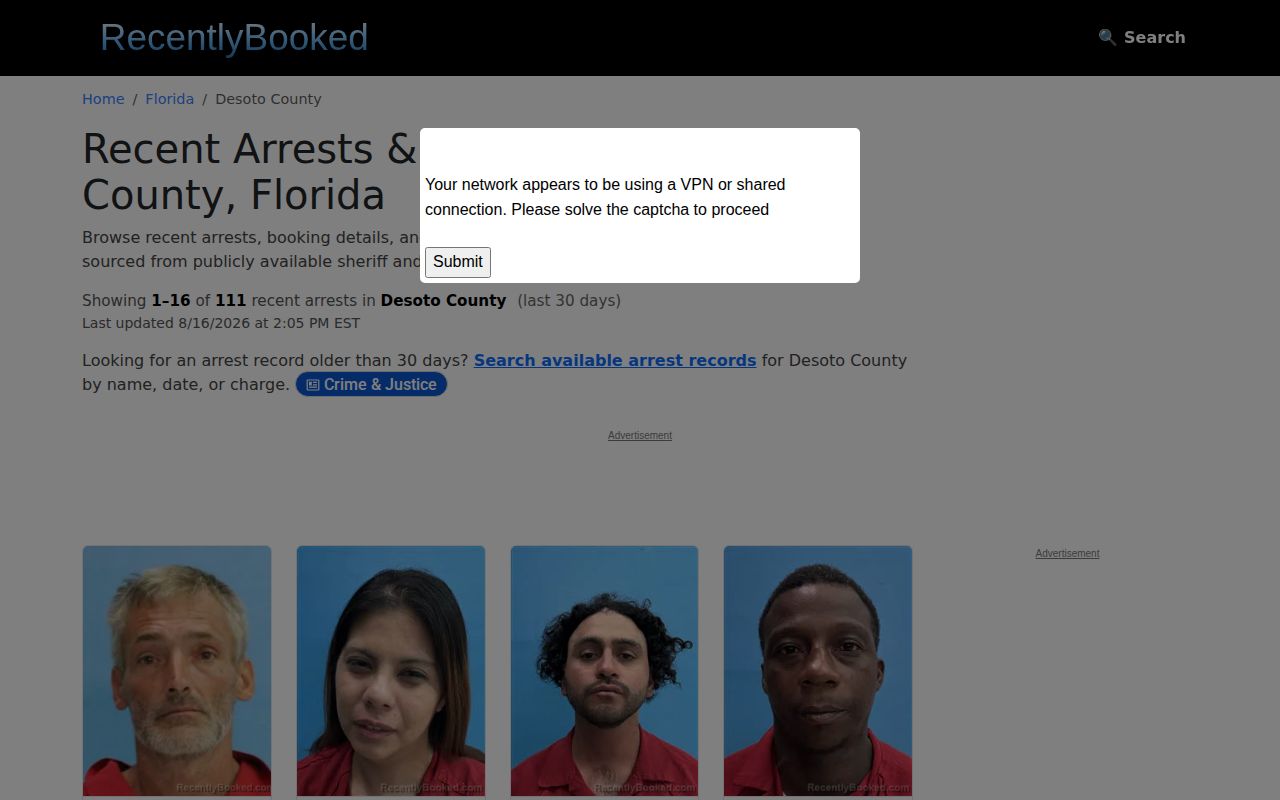
The rolling window and any refresh claim belong to the publisher. DCSO does not run it. So a missing entry proves nothing, and neither does a visible one.
Verify DeSoto News Tags
Data-quality problems show up here in two forms. The Busted Newspaper Arcadia tag once surfaced Sarasota material, so a city tag did not hold a clean county line. Arrests.org, meanwhile, showed odd field placement with values that made little sense. Read a copied card without context and you can land on the wrong location, agency, or personal detail.
An Arcadia address also does not mean Arcadia Police made the bust. Arcadia is DeSoto County's only incorporated city, yet DCSO, APD, Florida Highway Patrol, and other agencies all send arrestees to the shared county jail. Confirm the arresting agency and the case or communications number. The City Clerk holds APD incident reports; DCSO is the custodian for jail intake and booking photos.
Note: A city tag, mailing address, or caption is a discovery clue, not proof of the arresting agency or court jurisdiction.
Trace DeSoto Stories to Court
Tracing a story to a verified result means following the record creators. That route also catches quick releases, amended charges, no-file decisions, and namesake mix-ups. The DeSoto County booking and roster treatment walks through the county's search modes in full.
- Record the name, reported date, arresting agency, and exact charge wording from the story. Note any case or communications number.
- Search both Current and Released modes in the DCSO portal. A person can leave Current mode after release or transfer.
- If the portal is incomplete, ask DCSO for the booking card and photo. For an APD-originating report, ask the Arcadia City Clerk separately.
- Open the DeSoto Clerk OCRS search and compare names, dates, case type, and case number.
- Read the filed charge, hearing events, and latest disposition. Do not convert the first booking label into a conviction.
DeSoto's Clerk splits criminal work between divisions. Felonies go to circuit court; misdemeanors and criminal traffic go to county criminal. A single arrest can spawn several counts, and the booking date rarely matches the filing date, so check both. When a document cannot be viewed anonymously, use the Clerk's request channel instead of guessing from a short docket line.
DeSoto News Is Not Guilt
A booking entry captures what law enforcement logged at intake, nothing more. A news report reflects what an agency or reporter knew on publication day. Prosecutors can file a different charge, drop one, or dismiss the case outright. The ending lives in the court record.
Save the Florida Department of Corrections search for later. It applies only after someone enters state supervision or prison custody. It is not DeSoto County's same-day booking channel. Federal and immigration locators work the same way, answering only for their own systems and never the county jail. Match the source to the custody stage. That way a news item stays what it was meant to be: a story, not a status report.